Order before 2pm for next day delivery, or pre-book your date of choice. Delivery to Europe available from €23.99

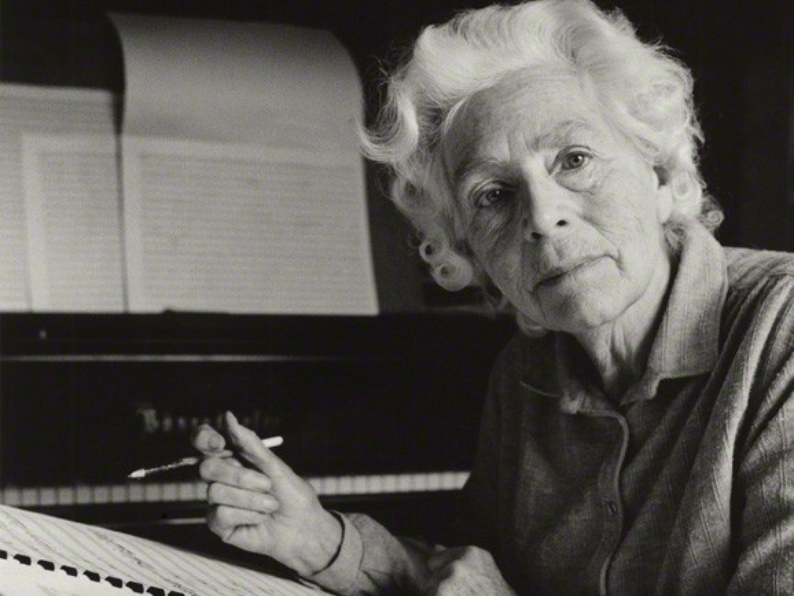
Teagan Jupiter and Elizabeth Maconchy

Post Category:
Gift Occasions Major
Teagan Jupiter and Elizabeth Maconchy
BasketsGalore.ie • Agent: Teagan Jupiter • Territory: Major Gift Occasions
How do you choose a gift when the occasion itself is uncommon?
Thank you. Congratulations. Welcome. Just Because. Sorry. Good Luck. New Home. Retirement. These occasions do not fit neatly into calendar dates or seasonal rhythms. They happen when they happen—when someone deserves recognition, when a relationship requires acknowledgment, when a moment calls for response. They are major not because of their scale but because of their weight: the situations where giving a gift matters, where gesture carries meaning, where the right choice communicates something that words alone cannot.
This is Teagan Jupiter's territory. For her, we chose Elizabeth Maconchy.
Maconchy is not widely known today, but during her lifetime she was considered one of the most substantial composers Britain and Ireland produced. Born in 1907 to Irish parents in Hertfordshire, she grew up partly in Dublin and always considered herself Irish. She spent nearly sixty years composing music that was uncompromising, intellectually rigorous, and driven by a single principle she articulated clearly: "For me, the best music is an impassioned argument."
• • •
Maconchy was drawn not to English pastoral music but to the modernism of Bartók and Janáček. After winning the Octavia Scholarship, she studied in Prague, where her Piano Concerto was performed in 1930. That same year, her cantata The Land premiered at the BBC Proms. She married William LeFanu, had two daughters (the younger, Nicola LeFanu, also became a composer), and in 1932 contracted tuberculosis, forcing her to move from London to the countryside.
She kept composing. Between 1932 and 1983, she wrote thirteen string quartets—the core of her achievement. She described the quartet form as a debate, a dialectic between four balanced, individual voices engaged in passionate argument. No single instrument dominates. Instead, they work together in tightly woven exchanges, establishing characters, clashing ideas, reacting to each other, sometimes reaching agreement, sometimes not. The music is dramatic, angular, emotionally taut.
Maconchy became the first woman to chair the Composers' Guild of Great Britain in 1959. She served as President of the Society for the Promotion of New Music. She was made a Dame in 1987. She composed over two hundred works in nearly sixty years, including operas, orchestral pieces, and songs. She died in 1994, respected by those who knew her work but never achieving widespread fame.

Why Elizabeth Maconchy for Teagan Jupiter?
Because major gift occasions, like Maconchy's string quartets, require balance. They involve multiple considerations: the relationship between giver and recipient, the context of the occasion, the message being conveyed, the appropriateness of scale. No single element dominates. Success comes from how these factors work together, how they respond to each other, how they create meaning through their interaction.
Maconchy understood this compositionally. Her quartets are not about individual instruments showcasing virtuosity. They are about conversation, negotiation, argument—four voices that must listen to each other, adjust to each other, build something together that none could achieve alone. The drama comes from the interplay, not from domination.
Major gift occasions operate identically. You are not simply selecting a product. You are calibrating: How well do I know this person? What does this moment require? What does my gesture need to communicate? How do I balance generosity with appropriateness? These are not questions with formulaic answers. They require judgment, attention, and the ability to hold multiple considerations in mind simultaneously.
• • •
Teagan Jupiter's territory includes occasions that funnel through two nodes: Personal Gifts and Impersonal Gifts. Welcome, Just Because, Sorry, New Home, Retirement, Good Luck—each can be either, depending on context. The same occasion requires different approaches depending on whether the recipient is family or a colleague, whether the relationship is intimate or professional, whether the gift acknowledges shared history or simply marks an event.
This duality mirrors Maconchy's compositional method. Her quartets move between moments of unity and moments of tension. Sometimes the four voices converge toward agreement. Sometimes they remain in productive disagreement. The music's power comes from its refusal to simplify, its willingness to hold complexity without forcing resolution.
Maconchy also represents something essential about working with integrity despite systemic barriers. She was told she would never compose seriously. She was denied recognition she had earned. She contracted tuberculosis and was forced into isolation. She kept working. Not because she was celebrated, but because the work itself demanded continuation. Her string quartets exist because she refused to accept that external circumstances should determine internal commitment.
Building a gifting business around major occasions requires similar discipline. These are not high-volume categories. They do not follow predictable patterns. Success requires maintaining capability year-round for events that happen irregularly. You cannot optimise major occasions the way you optimise seasonal products. You build infrastructure that remains ready, knowledge that accumulates, systems that improve through repeated application rather than through scale.

• • •
We are writing this in January 2026, at a moment when change is accelerating faster than any single person or organisation can fully track. Artificial intelligence is reshaping how decisions are made, how content is produced, and how businesses compete. In this environment, the easiest path is to become interchangeable, to optimise for speed, cost, and automation, and let everything else flatten.
We have chosen a different approach. We are intentionally building assets that compound over time: structured knowledge, cultural identity, creative systems, and decision frameworks that improve with use. Each agent, each composer association, and each piece of content contributes to a growing body of intelligence, not because it is novel, but because it is deliberate and cumulative.
Our purpose is practical. Life is limited, and the things that make it meaningful—music, well-chosen gifts, and work done with care—should be designed into everyday experiences, not treated as luxuries. This is our position in 2026: an Irish hamper business applying accumulated intelligence, a cultural lens that connects commerce with artistic heritage, and a commitment to building systems today that create durable strategic advantage tomorrow.
Teagan Jupiter. Elizabeth Maconchy. Impassioned arguments. Major occasions.
BasketsGalore.ie Agent Architecture
January 2026