Order before 2pm for next day delivery, or pre-book your date of choice. Delivery to Europe available from €23.99

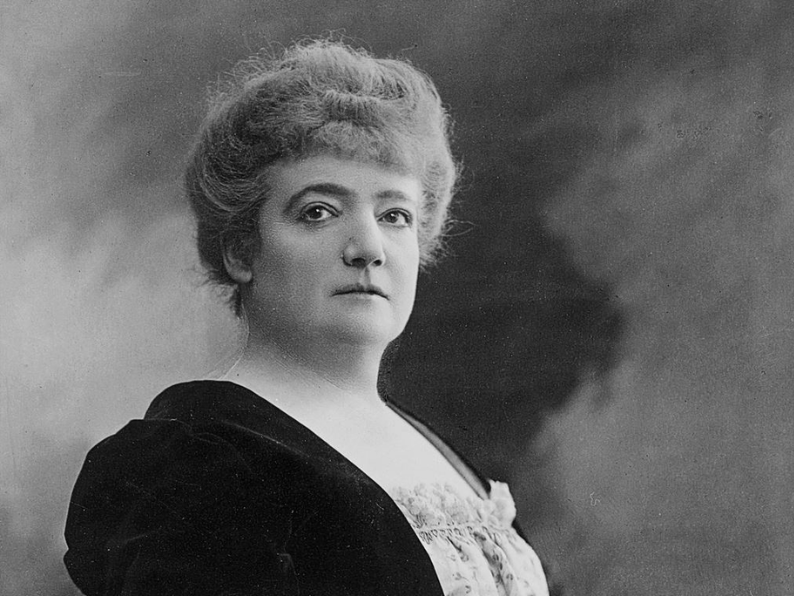
Saoirse Luna and Augusta Holmès

Post Category:
Christmas
Saoirse Luna and Augusta Holmès
BasketsGalore.ie • Agent: Saoirse Luna • Territory: Christmas Hampers
What does a 19th-century composer from Paris have to do with an Irish hamper company's Christmas season?
More than you might think. Our videos use music by women composers from the Celtic nations—Ireland, Wales, Scotland, and the broader Celtic world. Not stock libraries or generic tracks, but real composers whose work creates distinctive identity. Each of our digital employees—the agents representing different business territories—pairs with a composer whose music fits that territory's character. For Saoirse Luna, who represents Christmas hampers, we chose Augusta Holmès.
Holmès was a composer of Irish descent who lived in Paris, worked at massive scale, and never forgot her heritage. Christmas hampers are our defining season—the period of maximum intensity where everything built during the year either proves sufficient or doesn't. Holmès understood working at scale. She composed for 1,200 musicians. She wrote four-act operas. She tackled subjects critics told her to avoid. Her music required boldness and commitment. So does peak season.
• • •
Augusta Mary Anne Holmès was born in Paris in 1847 to Irish parents. Her father came from Youghal, County Cork. Her mother discouraged her musical ambitions, but when she died in 1858, Augusta's father allowed the eleven-year-old to begin serious study. She could not attend the Paris Conservatoire—women were barred from studying composition there—so she learned privately with César Franck. She published early works under a male pseudonym, "Hermann Zenta," because women composers were not taken seriously.
By her twenties, she had become a striking presence in Parisian artistic circles. Franz Liszt admired her work. Camille Saint-Saëns fell in love with her and proposed marriage; she refused. She had a long relationship with poet Catulle Mendès, with whom she had five children, though they never married. She lived as she composed: on her own terms.
Her music was grand, forceful, politically charged. Her 1882 symphonic poem Irlande evoked Irish heritage and ended with the words "Let Erin remember the days of old." When France celebrated the centenary of the Revolution in 1889, she was commissioned to write the Ode Triomphale—a massive work requiring 900 singers and 300 instrumentalists.
Critics called her music "masculine" and "virile," often as rebuke. Saint-Saëns complained of her "excessive virility—a frequent fault with women composers—and flamboyant orchestration in which the brass explodes like fireworks." She was praised for her gifts while being criticized for crossing into styles considered inappropriate for women. The message was clear: write songs, write salon pieces, but do not attempt symphonies or operas.
She attempted them anyway. Her opera La Montagne Noire premiered at the Paris Opéra in 1895—only the fourth opera by a woman staged there in the entire 19th century. It ran for thirteen performances, was harshly reviewed, and never performed again in her lifetime. She died in 1903 at fifty-five. For nearly a century, her work was almost entirely forgotten. Only in the 2010s have orchestras begun rediscovering and recording her music.

Why Augusta Holmès for Saoirse Luna?
Because Christmas hampers, like Holmès' music, operate at scale and intensity. Christmas is not a time for tentative production or cautious experimentation. It is the season when everything built during the year—supplier relationships, production systems, brand reputation—either proves sufficient or does not.
Holmès understood this musically. She wrote for 1,200 musicians. She composed four-act operas. She tackled epic subjects. She knew she would be criticized for it—women were supposed to limit themselves—but she composed what the work required, not what was considered acceptable.
Holmès also embodied Irish identity that travels. She never visited Ireland, but she composed Irlande. She befriended Irish nationalists including Maud Gonne, W.B. Yeats, John O'Leary, and Arthur Griffith. She played rousing Irish tunes on the piano at Gonne's apartment, infuriating the English neighbours who retaliated with "God Save the Queen." In 1897, her symphonic poem Irlande was performed at the first Feis Ceoil in Dublin, and she decided all future proceeds would go to the Gaelic League in Ireland.
This is identity as heritage and cultural memory rather than geography. Holmès knew she was Irish even though she lived in Paris. She claimed both identities—French citizen, Irish heart—and saw no contradiction. Christmas hampers work similarly. They are an Irish tradition sold worldwide. The product is rooted here, but it travels. The identity is unmistakable, but it is not limited to those who live within Irish borders.
• • •

We are writing this in January 2026. Artificial intelligence has made production faster, content generation cheaper, and differentiation harder. In this environment, businesses face a choice: optimise everything for efficiency, or build something that has character, that carries meaning, that cannot be instantly replicated.
We are building structures that compound over time. Each agent, each composer pairing, each piece of content adds to a framework that becomes more distinctive with use. Not because we are chasing novelty, but because we are constructing something with depth.
This is strategy, not sentiment. In a marketplace where everyone can produce at scale, advantage comes from accumulated intelligence: relationships that deepen, systems that improve, cultural associations that cannot be copied. Our competitors can produce Christmas hampers. They cannot reproduce twenty-five years of structured knowledge combined with a deliberate cultural identity that connects Irish business to Celtic musical heritage.
Augusta Holmès proved that ambition and heritage can coexist. She composed on the grandest scale while never forgetting where she came from. She was criticized for being too bold, too loud, too unwilling to conform—and she kept composing. Her work survives not because it was safe, but because it was distinctive.
The deeper purpose is straightforward. Life is limited, and the things that make it richer, such as music, meaningful gifts, and work done with care, deserve to be treated with seriousness, not nostalgia. Augusta Holmès built a fearless career by embracing scale, ambition and identity, refusing to dilute her voice despite criticism and convention. In that same spirit, this is our contribution: an Irish hamper business, a Celtic composer who honoured her heritage while shaping European culture, and a practical belief that the systems and decisions we build today can continue to generate value long after we've moved on.
Saoirse Luna. Augusta Holmès. Celtic fire. Seasonal light.
BasketsGalore.ie Agent Architecture
January 2026